Master data capture: what do frame and corner stop cost?
Master data simulation
Before a warehouse automation goes live, every article is measured, weighed and photographed once. One employee works through the assortment at one station, article by article. How long that takes depends on the handling and on every extra step the station asks for.
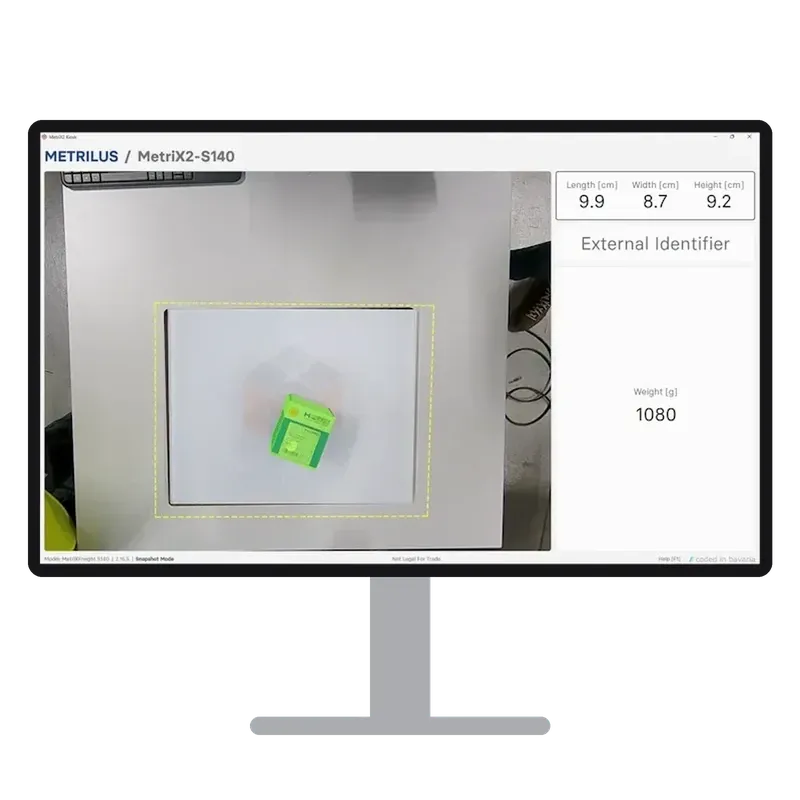
At the MetriXFreight S140 you put the article down without aligning it. The scan triggers the measurement, and dimensions, weight and photo are captured in about 200 milliseconds. That way you handle up to 750 articles per hour including the scan. The simulation compares the S140 with two common designs. At a light-grid station you pull a measuring gate over the article by hand and then confirm the values. At a station with a corner stop you push every article into the corner and start the measurement. Use the switch to choose whether you work out the initial capture of your assortment or the daily business in receiving.
take out, put on, take off, put away
assumption, preset per design; at the light grid the pull of the gate
a separate step at the comparison station, part of the measurement at the S140
The same working hour, two stations
MetriXFreight S140
Light-grid station
Top view. On the left is the crate with the articles, on the right the crate for captured ones. In between is the scale, where every article lies still while it is measured. The animation shows one example hour with the same articles at both stations. Its counter applies to that hour only. The figures below are calculated values. The S140 measuring field stays lit longer than the measurement takes, so you can see it in time lapse.
working days for 15,000 articles. With the S140 you are done 2.3 times as fast.
This is a simulation with simplified assumptions, not a promise for your operation. It compares the time needed only, not measuring accuracy. In practice the result depends on many factors, such as article mix, handling, workstation and staff.
With the S140 you need 31.7 hours of working time, with the light-grid station 72.2. That is 40.5 hours or 56 % less, one employee at one station.
What does one second of measuring cycle cost?
Working hours for the assortment over the measuring cycle of the comparison station. The dot is the cycle you set. The S140 measures in about 200 ms, so its line stays flat.
Model and assumptions
- From the product data: the S140 measures in about 200 ms and handles up to 750 articles per hour including the scan. This data-sheet value is the best case. The simulation reaches it at the fastest handling the control allows: 3.1 s handling, 1.5 s scan and 0.2 s measuring add up to 4.8 s per article. It never shows more for the S140.
- Sequence at the S140 per article: put it on without aligning it, scan, the scan triggers the measurement, dimensions, weight and photo are captured in one step, put it away. Sequence at the light-grid station, as described in operating manuals of such devices: put it on, pull the measuring gate over the plate in one go (that is the measurement), take the photo if needed, check and confirm the values on the screen, scan, put it away. The next pull goes the other way. Sequence at the station with corner stop: put it on, push it into the corner until it touches both walls, start the measurement, wait for the measuring cycle, take the photo if needed, scan, put it away, wait until the scale is back at zero. The article always lies still while it is measured.
- Assumptions, not measurements: scanning takes 1.5 s, the photo at the comparison station 1 s. At the light-grid station pulling the gate takes 5 s by default, checking and confirming 1.5 s. At the station with corner stop pushing into the corner takes 2 s, starting the measurement 1 s, the measuring cycle 4 s by default and zeroing the scale 1 s. You set the measuring cycle from 2 to 10 s and the handling yourself; the handling default is 4 s. A working day has 8 hours. The employee measures for the share you set, 75 % by default, adjustable from 50 to 100 %. The rest is breaks, walking, fetching and returning goods, set-up and idle time, the same at both stations. Makers of such devices state measuring times of a few seconds, without handling. The values here are assumptions too, not a manufacturer's figures.
- Calculation: the time per article is the sum of the steps. Working time for the assortment = articles times time per article, divided by 3,600 s and by the productive share, rounded to one decimal. Working days = working time divided by the day length. Articles per hour without breaks = 3,600 s divided by the time per article, rounded down, for the S140 at most up to the data-sheet value. The assortment can be set between 1,000 and 50,000 articles. In daily business: working time per year = articles per day times 220 working days (assumption) times time per article, divided by 3,600 s and by the productive share, rounded to whole hours. Minutes per day = hours per year times 60 divided by 220. The “times as fast” factor is the ratio of the times per article. The quantity per day can be set from 10 to 1,000 articles.
- Example with the defaults (light-grid station, with photo, 75 % productive): the S140 takes 4 + 1.5 + 0.2 = 5.7 s per article, so 31.7 hours of working time for 15,000 articles. The light-grid station takes 4 handling + 5 gate + 1 photo + 1.5 confirm + 1.5 scan = 13 s, so 72.2 hours of working time.
- Animation: one example hour without breaks, the same for every visitor. As soon as an article is put away, the next one comes. Each manual step takes up to 20 % less or more per article and as long as set on average. Measuring and photo times are fixed. That is why the counter of the animation differs slightly from the calculated articles per hour.
- Not included: failed and repeated measurements, costs. Breaks, walking and set-up are covered as a flat share in the productive share. The simulation does not compare measuring accuracy.
And after the initial capture?
Once the assortment is captured, the S140 stays in use. In receiving it measures every new article on its first arrival, before it goes into storage. If a supplier changes the packaging or a seasonal range changes, you simply measure the affected articles again.
Because the scan triggers the measurement and the photo is taken at the same time, this fits into the normal routine in receiving. The values go straight into your WMS or ERP via REST API, file or QR code. How much working time that makes over a year is shown in the daily business scenario of the simulation above. With a battery you provide and Wi-Fi or LTE, you can also move the station to where the goods are. How to organise this at a fixed or mobile station is explained in Automate master data capture.
And for your assortment?
The simulation compares the time needed only. Which station suits your articles also depends on size, material and the accuracy your WMS needs. We work through it with you: get in touch. You can find more about the system at S140 master data capture.