Parcel station: what the measuring cycle costs
Station simulation
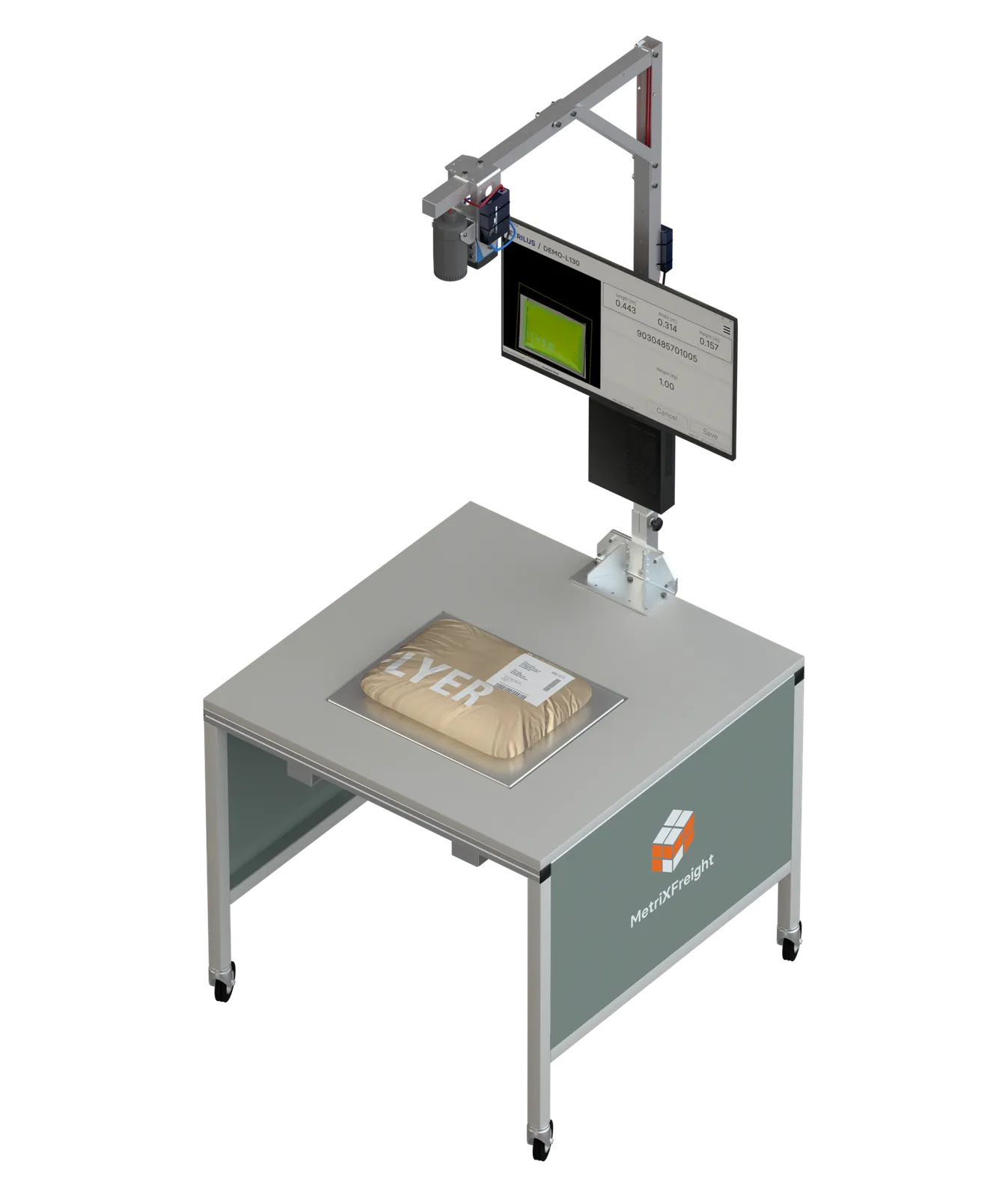
At a manual parcel measuring station one employee pushes parcel after parcel onto a roller table with a scale. The parcel lies still, is measured and scanned, then the next one follows. How many parcels the station handles per hour depends on the handling and on the measuring cycle.
The MetriXFreight L13x measures in about 200 milliseconds, and the scan triggers the measurement. One station handles up to 1200 parcels per hour including the scan. The simulation compares it with a measuring system where you trigger the measurement by hand and the measuring cycle takes several seconds. Use the three controls to see how much that matters at your station.
push onto the table and onwards
assumption, the parcel rests meanwhile
The same hour, two stations
MetriXFreight L13x
Comparison system
Top view. Parcels come from the left onto the roller table with scale. In both cases the parcel lies still while it is measured. The animation shows one example hour with random arrivals, the same for both stations. Its counters apply to that hour only: a parcel is done once it has been measured and pushed onwards. All other parcels that have arrived are not done yet. The figures below are calculated values. The L13x frame stays lit longer than the measurement takes, so you can see it in time lapse.
more parcels per hour at the same station with the L13x
This is a simulation with simplified assumptions, not a promise for your operation. In practice the result depends on many factors, such as parcel mix, handling, workstation and staff.
With the L13x the station handles all 500 parcels. With the comparison system 122 parcels are still waiting at the end of the hour.
What does one second of measuring cycle cost?
Parcels handled per hour over the measuring cycle of the comparison system. The dot is the cycle you set. The L13x measures in about 200 ms, so its line stays flat.
Model and assumptions
- From the product data: the L13x measures in about 200 ms and handles up to 1,200 parcels per hour including the scan. This data-sheet value is the best case. The simulation reaches it at the fastest handling the control allows: 1.3 s handling, 1.5 s scan and 0.2 s measuring add up to 3 s per parcel. It never shows more for the L13x.
- Sequence with the L13x per parcel: push on, scan, the scan triggers the measurement, push onwards. Sequence with the comparison system: push on, trigger the measurement by hand, wait for the measuring cycle, scan, push onwards. In both cases the parcel lies still on the roller table while it is measured.
- Assumptions, not measurements: scanning takes 1.5 s, triggering by hand 1 s. You set the handling; the default is 4 s. The measuring cycle of the comparison system can be set from 1 to 5 s; the default is 3 s. That is an assumption too, not a manufacturer's figure.
- Calculation: the time per parcel is the sum of the steps. Capacity per hour = 3,600 s divided by the time per parcel, rounded down to whole parcels. Parcels per hour = the smaller of arriving parcels and capacity. Waiting at the end of the hour = arriving minus handled parcels. The working time per 1,000 parcels is the time per parcel times 1,000, without idle time.
- Example with the defaults: the L13x takes 4 + 1.5 + 0.2 = 5.7 s per parcel, which gives a capacity of 631 parcels per hour. The comparison system takes 4 + 1 + 3 + 1.5 = 9.5 s, which gives 378.
- Animation: one example hour, the same for every visitor. Parcels arrive at random moments spread over the hour. Each manual step takes up to 20 % less or more per parcel and as long as set on average. The measuring times are fixed. One employee, one station, handled in order of arrival. Because the arrivals are random, the counters of the animation differ from the calculated values.
- Not included: failed and repeated measurements, breaks, infeed and removal, costs.
And at your station?
The longer the handling per parcel takes, the less the measuring cycle matters. The simulation shows that too. We work through your parcels and volumes with you: get in touch. You can find more about the system at L13x parcel dimensioning.