Static or dynamic dimensioning: measure standing still or driving through?
Cross-dock simulation
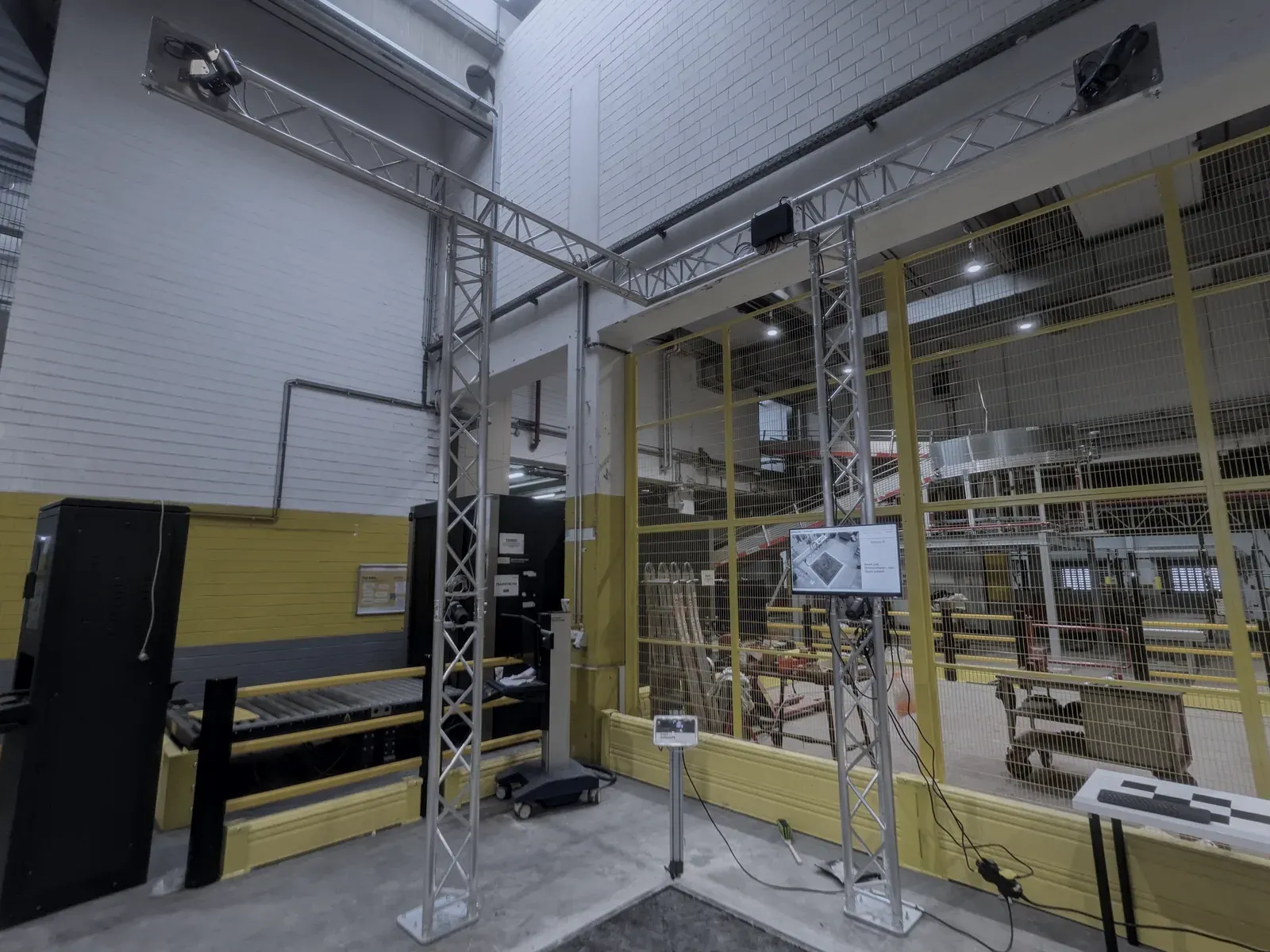
With static dimensioning, the load stands still while it is measured. With dynamic pallet dimensioning, the forklift drives the pallet through a measuring gate. MetriXFreight measures statically: the forklift only sets the pallet down briefly, the forks stay in the pallet, and the measurement itself takes around 200 milliseconds.
Driving through looks faster because nobody stops. But the route to the gate can cost more time than the measurement. A gate for measuring in motion sits at one point in the facility, and every pallet has to pass it. A MetriXFreight station sits close to the inbound door. The simulation below runs the same evening cross-dock shift with both methods.
How static and dynamic dimensioning differ
Static: The pallet is measured while it stands. Depending on the system, the forklift has to drive out of the measuring field for this. With MetriXFreight it only sets down briefly, the forks stay in the pallet, and there are no moving parts. Because stations can stand where the forklift passes anyway, they are easy to spread across several doors.
Dynamic: The forklift drives the pallet through a measuring gate without stopping. Every pallet that needs measuring has to pass through the gate. How much time this saves or costs depends on the routes in your facility.
When each method fits
For throughput, it matters less whether the pallet stands or moves while it is measured than how much travel and waiting your process costs overall. If pallets are spread over many doors, stations at the doors save travel. If every pallet passes one fixed point anyway, the detour to the gate disappears. Use the controls in the simulation to see when each method is faster.
Whether you may bill by the dimensions does not depend on the method but on the approval of the system. What that means is explained on the page Legal-for-trade volume measurement.
against one in-motion gate
100 % read rate, full speed, no headway
The same evening, two methods
18:30MetriXFreight, standing
In-motion gate in the centre aisle
Top view. Inbound doors at the bottom, outbound doors at the top. Both halls get the same trucks and pallets.
longer per pallet through the in-motion gate
This is a simulation with simplified assumptions, not a promise for your operation. In practice the result depends on many factors, such as hall layout, routes, volumes, staff and procedures.
MetriXFreight is faster as long as the stop is shorter than 14 s. Currently set: 5 s.
How long may the stop take?
Time per pallet from the inbound door to staging. The dot is the stop you set. Break-even is where the lines cross.
One MetriXFreight station costs less than an in-motion gate. So several groups of inbound doors can each have their own.
Model and assumptions
- Hall: 20 inbound doors opposite 20 outbound doors, 92 × 40 m, one centre aisle. Per evening 90 trucks with about 1,080 pallets and 8 forklifts.
- Forklifts: 8 km/h loaded, 10 km/h empty, 12 s to pick up, 10 s to set down, at most 2 forklifts on one truck at a time.
- MetriXFreight: the forklift sets the pallet down briefly and the forks stay in the pallet. The stop covers braking, lowering, measuring, lifting and moving off. Stations sit 10 m behind the inbound doors and are occupied for 6 s per pallet, read rate 99.5 %.
- In-motion gate: one gate in the middle of the centre aisle, the best place for it. 10 m measuring section, passage in both directions at 5 km/h, one forklift in the section at a time plus 2 s headway, read rate 95 %. After a misread the forklift turns and drives through again; after the second, the pallet is measured by hand in 120 s. If the destination lies behind the gate, turning costs 6 s. These are assumptions, not a manufacturer's figures.
- Ideal gate: 100 % read rate, passage at the full 8 km/h, no headway. The route via the centre aisle remains.
- Numbers: averages of 30 simulated evenings. Time per pallet means from the inbound door to staging in front of the outbound door. The animation shows one fixed evening.
- Not included: oncoming traffic in the aisle, purchase cost, other hall layouts.
Frequently asked questions about static and dynamic dimensioning
What is the difference between static and dynamic pallet dimensioning?
With static dimensioning, the pallet stands still while it is measured, for example when the forklift sets it down. With dynamic dimensioning, it passes through a measuring gate without stopping. Static stations are easy to spread across several doors; with a gate, every pallet has to pass through it.
Does the pallet have to stop with MetriXFreight?
Briefly, as when setting down or scanning. Because the forks stay in the pallet, the forklift neither leaves the measuring field nor drives back in, and the measurement takes around 200 milliseconds.
What throughput is realistic with MetriXFreight?
The pallet systems L23x and L33x manage 300 to 600 measurements per hour per station, including the scan. How many pallets you handle in an evening depends on routes and stations. The simulation above shows this.
How accurate is static pallet dimensioning with MetriXFreight?
The legal-for-trade pallet systems L235 and L335 measure under OIML to ±2 cm in length and width and ±1 cm in height, under NTEP to ±0.5 in for all three dimensions.
What about your facility?
The result holds for the facility shown here. We will work through your doors, routes and volumes with you: get in touch. The simulation holds for both pallet systems: L23x pallet dimensioning and L33x for black-wrapped pallets. For long goods and bulky freight up to 6.5 meters there is the L63x long-goods measurement. If you already measure while the pallet is stationary, the second comparison helps: Static pallet dimensioning: what the stop costs