Legal-for-trade volume measurement: approval, measuring range and certificates
When you need legal-for-trade measurements and which systems are approved for it
Ask about a legal-for-trade variantLegal-for-trade means that an independent body has examined the design of a measuring system and confirmed that it meets the legal requirements for measuring instruments used in billing. For MetriXFreight, these are the variants L135, L235, L335 and L635. They hold an EU type-examination certificate under the Measuring Instruments Directive (MID) and an OIML certificate, both issued in the Netherlands. L135, L235 and L335 are also NTEP-certified for the USA.
You usually need legal-for-trade measurements when you bill by dimensions or volumetric weight, for example in freight forwarding, parcel services or air freight. Your national metrology authority has the final word.
What legal-for-trade means and what it does not
The certificates apply to the design: sensors, computer and the legally relevant software. How each individual system is placed on the market and put into service is governed by national legal metrology law. It is installed and sealed as the certificate specifies.
Anyone who uses measured values has obligations of their own. In Germany, for example, the Measures and Verification Act requires that an invoice based on measured values can be traced by its recipient. Your national metrology authority can tell you what applies at your site. We support you with this.
Choose region and product line
Which variant is legal-for-trade where
Choose where you bill and which product line you use. You see which variant is approved for it, its display increment (scale interval) and its accuracy.
- Measure The platform calculates length, width and height from the point cloud.
- Volumetric weight The platform calculates the volumetric weight automatically.
- Bill If you bill by dimensions or volumetric weight, you usually need legal-for-trade measurements.
How the legal-for-trade variant displays
With OIML R129, EU type-examination certificate (MID), the L135 displays length/width in steps of 1 cm and height in steps of 0.5 cm.
Section 10 cm One tick = one display step Orange: accuracy around the measured value
For comparison: the standard variant L130 displays in steps of 1 mm, without verification.
With NTEP, the L135 displays length/width/height in steps of 0.5 in.
Section 4 in One tick = one display step Orange: accuracy around the measured value
For comparison: the standard variant L130 displays in steps of 1 mm, without verification.
With OIML R129, EU type-examination certificate (MID), the L235 displays length/width in steps of 2 cm and height in steps of 1 cm.
Section 10 cm One tick = one display step Orange: accuracy around the measured value
For comparison: the standard variant L230 displays in steps of 1 mm, without verification.
With NTEP, the L235 displays length/width/height in steps of 0.5 in.
Section 4 in One tick = one display step Orange: accuracy around the measured value
For comparison: the standard variant L230 displays in steps of 1 mm, without verification.
With OIML R129, EU type-examination certificate (MID), the L335 displays length/width in steps of 2 cm and height in steps of 1 cm.
Section 10 cm One tick = one display step Orange: accuracy around the measured value
For comparison: the standard variant L330 displays in steps of 1 mm, without verification.
With NTEP, the L335 displays length/width/height in steps of 0.5 in.
Section 4 in One tick = one display step Orange: accuracy around the measured value
For comparison: the standard variant L330 displays in steps of 1 mm, without verification.
With OIML R129, EU type-examination certificate (MID), the L635 displays length/width in steps of 2 cm and height in steps of 1 cm.
Section 10 cm One tick = one display step Orange: accuracy around the measured value
For comparison: the standard variant L630 displays in steps of 1 mm, without verification.
The L635 has no NTEP approval. In the EU it is legal for trade: OIML R129, EU type-examination certificate (MID).
The certificates
- EU type-examination certificate
- Number
- T12421, Revision 3
- Issued by
- NMi Certin B.V., notified body 0122, the Netherlands
- Basis
- Measuring Instruments Directive 2014/32/EU (MID)
- Covers
- MetriXFreight L135, MetriXFreight L235, MetriXFreight L335 and MetriXFreight L635
- First issued
- 09/12/2022
- Date of this revision
- 04/08/2025
- Valid until
- 09/12/2032
- OIML certificate
- Number
- R129/2020-A-NL1-24.03
- Issued in
- the Netherlands
Certified measuring range
- Certified measuring range L135
- Smallest object (L × W × H)
- 10 × 10 × 5 cm
- Largest object (L × W × H)
- 150 × 120 × 90 cm
- Scale interval (L / W / H)
- 1 / 1 / 0.5 cm
- Scope of use
- For singulated objects. Only rectangular and pillow-shaped objects; transparent packaging is not included in the measurement.
- Certified measuring range L235 and L335
- Smallest object (L × W × H)
- 20 × 20 × 10 cm
- Largest object (L × W × H)
- 260 × 260 × 260 cm
- Scale interval (L / W / H)
- 2 / 2 / 1 cm
- Minimum spacing between objects
- 10 cm
- Scope of use
- For rectangular objects and static palletised freight of irregular shape; transparent packaging is not included in the measurement.
- Certified measuring range L635
- Smallest object (L × W × H)
- 20 × 20 × 10 cm
- Largest object (L × W × H)
- 650 × 260 × 260 cm
- Scale interval (L / W / H)
- 2 / 2 / 1 cm
- Minimum spacing between objects
- 10 cm
- Scope of use
- For rectangular objects and static palletised freight of irregular shape; transparent packaging is not included in the measurement.
Legal-for-trade weighing with your scale
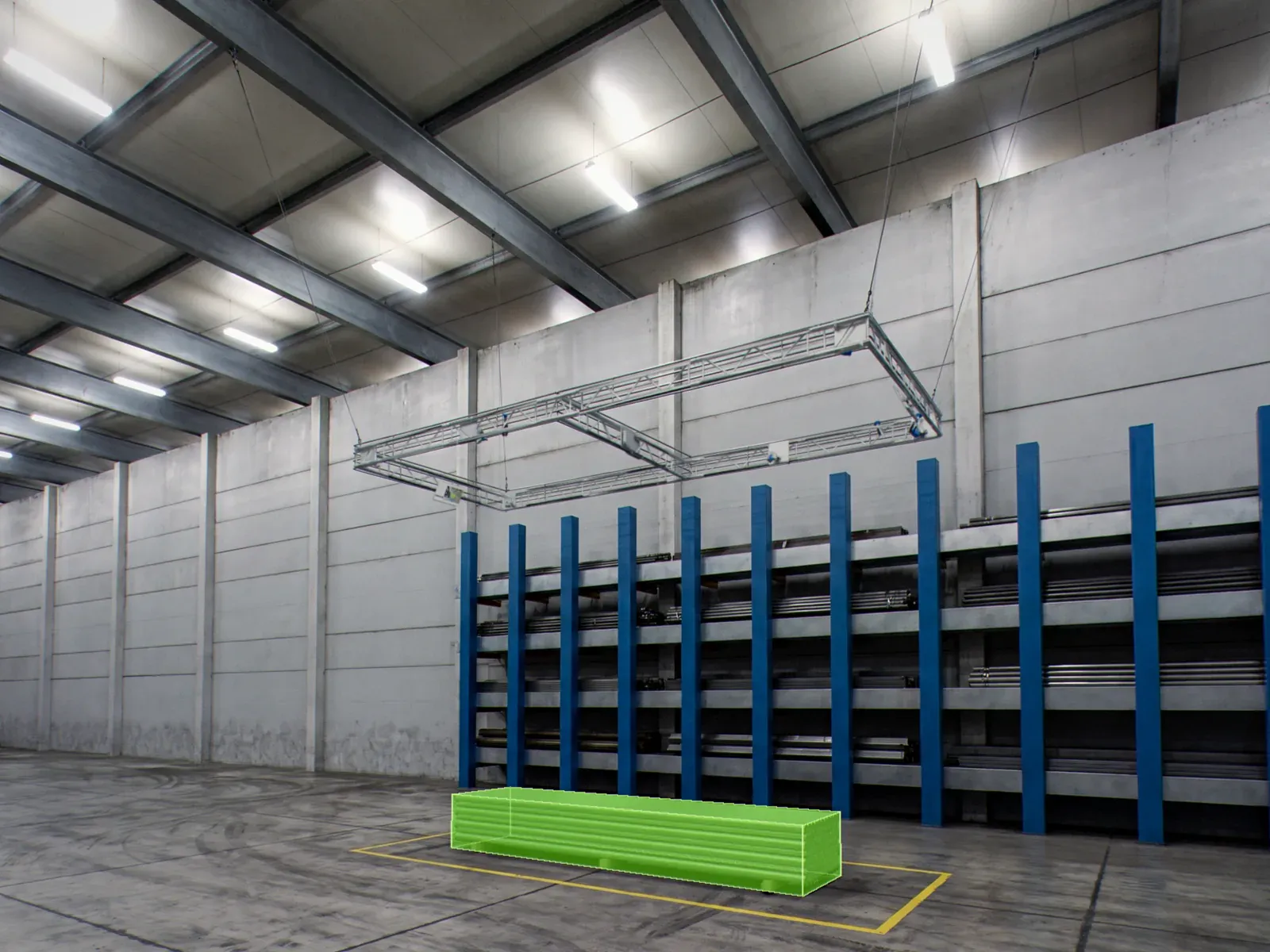
The certificates cover the dimensions. The weight comes from a scale. According to the certificate, only a scale that meets the requirements of the EU directive on non-automatic weighing instruments may be connected to the legal-for-trade system.
With the pallet and long-goods systems, you provide the scale and we connect it to MetriXFreight.
 AI-generated
Where the approval ends
Legal-for-trade measurement applies only within the certified measuring range shown above for each variant. Transparent packaging is not included in the measurement. The pallet and long-goods systems require a minimum spacing between two objects, and the L135 measures singulated objects only. According to the certificate, values outside the measuring range may only be shown with a note that they are not legal-for-trade. They are not stored in the system. With the L135, the roller conveyor or table setup limits the object size in practice to 135 × 80 × 90 cm.
The standard variants L130, L230, L330 and L630 are not approved for billing. Which variant suits your freight is shown in the solutions overview.
Frequently asked questions about legal-for-trade volume measurement
What is the difference between MID and OIML?
MID stands for the European Measuring Instruments Directive, and the EU type-examination certificate confirms that the design meets its requirements. OIML is the International Organization of Legal Metrology. Its recommendation for multi-dimensional measuring instruments describes the metrological requirements, and the OIML certificate confirms conformity with it. On its own, an OIML certificate is not an approval for a specific country.
How accurate are the legal-for-trade variants?
The L135 measures to ±1 cm in length and width and ±0.5 cm in height. L235, L335 and L635 measure to ±2 cm in length and width and ±1 cm in height. In the USA, the NTEP tolerance is ±0.5 in.
How does legal-for-trade measurement with cameras work?
3D sensors capture the shipment, and the software calculates length, width and height. Legally relevant parts include the calculation, storage in a protected file and the check against a reference object at start-up and at regular intervals. The configuration is protected by checksums. If the system detects a change to legally relevant parameters, it locks itself.
Is the L635 legal-for-trade in the USA too?
No. The L635 holds the EU type-examination certificate and the OIML certificate, but no NTEP approval. L135, L235 and L335 are NTEP-certified.
Can I switch an existing system to the legal-for-trade variant?
Talk to us. Whether and how this works depends on the product line and the installation.
More answers on throughput, installation and operation are in the FAQ.