PPWR empty space: why it starts with item master data
What the PPWR says about empty space and how to calculate it
Request a demoThe EU Packaging and Packaging Waste Regulation (PPWR) will limit the empty space in grouped packaging, transport packaging and e-commerce cartons to at most 50 %, from 2030 at the earliest. Empty space is the volume of the carton minus the volume of the packaged items inside, and filling material counts as empty. To calculate the ratio you therefore need two sets of dimensions: the carton's and every item's.
You usually know the carton dimensions. The item dimensions are often missing or wrong. That is why empty space starts with master data.
What the PPWR says about empty space
Regulation (EU) 2025/40 has applied since 12 August 2026. For empty space it sets a deadline: whoever fills grouped packaging, transport packaging or e-commerce packaging must make sure the empty space ratio is at most 50 %.
- From when: from 1 January 2030 at the earliest. What counts is the later of two dates: that day, or three years after the calculation method enters into force, which the European Commission has to set by 12 February 2028. If the method only enters into force in 2028, the limit applies from 2031.
- What counts as empty: the space between carton and items, even when it is filled with paper, air cushions, foam or chips.
- What the method has to take into account: irregular products and shipments with several items. Also liquid and fragile products, small products that larger ones could damage, and the area for the shipping label.
- Who is exempt: anyone who uses the sales packaging itself as shipping packaging, such as the product box with a label, and anyone using reusable packaging in a re-use system. That sales packaging still has its own rules on packaging minimisation.
The obligation lies with whoever fills the carton: the online retailer, the fulfilment provider, the contract logistics company.
Why it starts with item master data
The empty space ratio is a calculation from two volumes. For the volume of the items you need their dimensions, as they go into the carton in their packaging.
- Choosing the right carton size: Your WMS or packing software can only suggest the smallest carton that fits if it knows the dimensions of every item. Without master data people pack by feel, and the empty space is left to chance.
- Several items in one carton: For an order with several items you add up their volumes. If a single value is missing, the ratio cannot be calculated.
- Backing up the ratio: If you want to show how you arrived at your figure, you need measured dimensions rather than estimates from supplier data.
Once you have captured the item dimensions properly, you can calculate the empty space for every carton size and every order.
Capture items and cartons with the S140
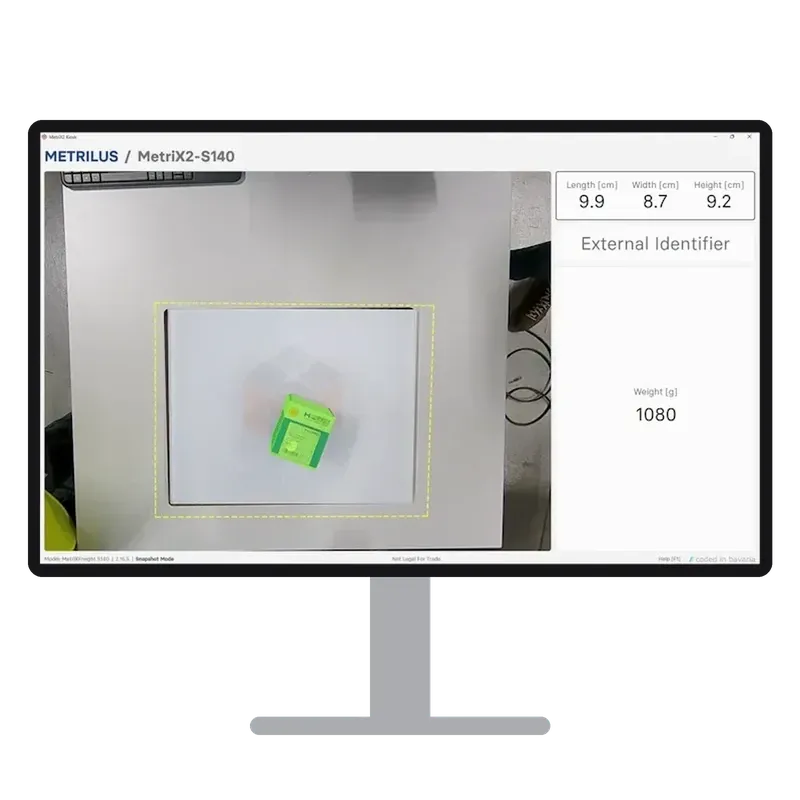
The MetriXFreight S140 captures length, width, height, weight and a photo of every item in a single step, with less than 5 mm mean deviation. It measures cartons as well as irregularly shaped items up to 120 × 85 × 70 cm. So you capture your product range, your carton sizes and samples of packed cartons at the same station, up to 750 objects per hour including the scan, depending on handling.
The S140 gives the dimensions as the enclosing box. For irregular items that volume is larger than the real one, so the empty space looks smaller than it is.
In ongoing shipping, the L13x measures the packed parcels. In MetriXOne, our cloud dashboard, all measurements of your systems sit in one place, with their photos.
Calculate the empty space ratio
The calculation
Empty space ratio = (volume of the shipping packaging − volume of the sales packaging inside) ÷ volume of the shipping packaging
Filling material such as paper, air cushions or foam counts as empty space.
The limit
At most 50 % for grouped packaging, transport packaging and e-commerce packaging, from 1 January 2030 at the earliest.
The European Commission still has to set the exact calculation method in an implementing act, including for irregular products and shipments with several items.
Worked example
An item of 30 × 25 × 20 cm (15,000 cm³) sits in a carton of 40 × 30 × 30 cm (36,000 cm³). 21,000 cm³ stay empty, that is 58.3 %, more than 50 %. In a carton of 35 × 30 × 25 cm it is 42.9 %.
- How do you capture the dimensions of your whole product range? Automate master data capture
- How many working days does your product range take at a measuring station? Simulate your product range
What the calculator does not know
The calculator works with box dimensions, the way master data is stored in most systems. For irregular items the enclosing box is larger than the real volume, so the empty space looks smaller than it is.
Whether the inside or the outside of the carton counts, and how several items or fragile goods are treated, is only settled by the Commission's calculation method. So take the result as guidance for your carton sizes, not as proof.
Frequently asked questions on PPWR empty space
What is the empty space ratio under the PPWR?
The ratio of the empty space to the total volume of the shipping packaging. Empty space is the volume of the packaging minus the volume of the sales packaging inside it. Filling material counts as empty space.
From when does the 50 % empty space limit apply?
From 1 January 2030 at the earliest. What counts is the later of two dates: that day, or three years after the European Commission's calculation method enters into force. The Commission has to set the method by 12 February 2028.
Who has to comply with the empty space limit?
Whoever fills grouped packaging, transport packaging or e-commerce packaging, for example online retailers and fulfilment providers.
Does filling material count as empty space?
Yes. Space filled with paper, air cushions, bubble wrap, foam, wood wool or polystyrene chips counts as empty space.
Does the limit apply if I ship in the product box?
No. Anyone who uses the sales packaging itself as shipping packaging is exempt from the empty space limit. The same goes for reusable packaging in a re-use system. The sales packaging itself still has its own rules on packaging minimisation.
Which data do I need to calculate the empty space?
The dimensions of the carton and of every item, as it goes into the carton in its packaging. Together they give the ratio, for every carton size and every order.
Does the S140 make my packaging PPWR-compliant?
No, no measuring system can do that. As the one who fills the packaging, you are responsible for the empty space. The S140 gives you measured dimensions of items and cartons to plan carton sizes and calculate the ratio.