Time-of-flight camera: how light travel time becomes freight dimensions
How it works, its limits and the path to the point cloud
Request a demoA time-of-flight camera (ToF camera) measures for each pixel how long light takes to reach the object and come back. This produces a depth image of the whole scene, and from the depth image the software reconstructs the freight as a point cloud: length, width, height and volume.
All MetriXFreight systems measure with time-of-flight. This page explains the principle, the typical disturbances and how we deal with them.
What is inside a time-of-flight camera
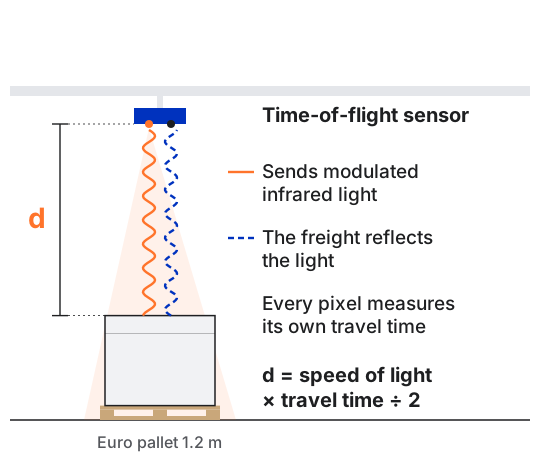
At its core, a time-of-flight camera consists of three parts: an infrared illumination, a lens and an image sensor whose pixels evaluate not only brightness but also the travel time of the light.
In the design that MetriXFreight uses, this evaluation takes place directly in the pixel. Each pixel delivers its own distance, the camera stays compact, and the data can be processed quickly.
Two ways to measure travel time
Direct time-of-flight sends short light pulses and stops the clock until they come back. LiDAR sensors work this way. Because light travels only around thirty centimetres in a nanosecond, this needs extremely fast electronics.
Indirect time-of-flight modulates the light, so it gets brighter and darker very quickly. The camera compares the emitted wave with the returning wave. The further away the object is, the more the returning wave is shifted. From this phase shift, the camera calculates the distance. MetriXFreight works with indirect time-of-flight.
Try it yourself
The unambiguous range
A wave repeats. If an object is so far away that the shift exceeds one full wave, the phase starts again from the beginning, and the camera reads a distance that is too short. How far a camera measures unambiguously therefore depends on the modulation frequency: the higher the frequency, the finer the measurement, but the shorter the unambiguous range.
The solution is to combine several modulation frequencies. Each has its own unambiguous range, and the true distance is the one at which all of them agree. This way, the camera combines fine resolution with sufficient range.
What can disturb a time-of-flight camera
Every measuring method has limits. With time-of-flight, they are these:
- Multipath reflections. Light that returns via a wall or a neighbouring object travels a longer path and distorts the distance. A clear measuring field and suitable mounting keep this effect small.
- Flying pixels at edges. A pixel at an edge sees foreground and background at the same time and delivers a mixed value. The software detects and filters such points.
- Movement. The camera records several phase images one after the other. If the freight moves during this, errors appear at the edges. MetriXFreight therefore measures the freight during the brief stop.
- Several cameras. If several time-of-flight cameras illuminate the same scene, they disturb each other. Our systems operate their sensors so that they do not disturb each other.
- Dark and reflective surfaces. Little or deflected light comes back. This applies to all optical methods. With MetriXFreight, the L33x also measures black foil; with the L23x and L63x, restrictions are possible with black foil and transparent or highly reflective surfaces, with the L13x with transparent or highly reflective surfaces. The S140 measures all items except entirely non-reflective or highly reflective ones.
- Ambient light and temperature. Strong ambient light degrades the signal, and the measured values depend on temperature. Our systems are designed for warehouses without direct sunlight on the measuring surface.
How the point cloud becomes length, width and height
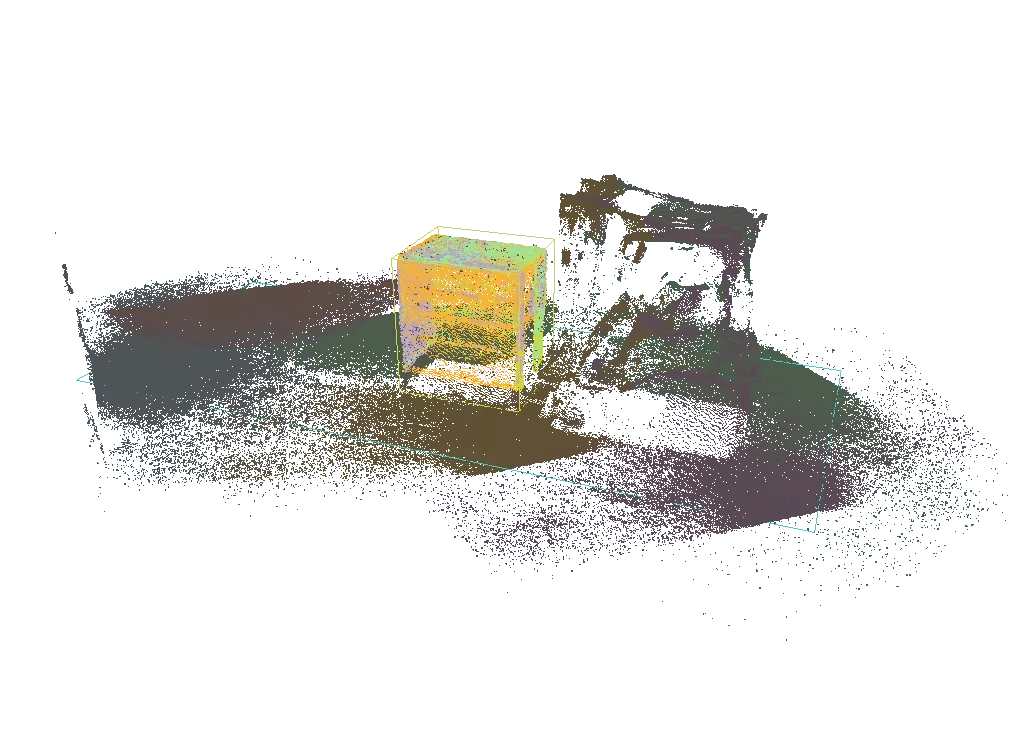
A system with several time-of-flight cameras sees the freight from different directions. The software merges the depth images into one common point cloud, separates the freight from the floor and the load carrier, and calculates length, width, height and volume from it.
How accurately this works and which variants measure legal for trade is explained on the page about legal-for-trade volume measurement.
Time-of-flight compared
Besides time-of-flight, there are structured light, stereo and laser line scanners. How they work and why metrilus relies on time-of-flight for freight is shown in the comparison of 3D sensing methods.
Frequently asked questions about the time-of-flight camera
How does a time-of-flight camera work?
It illuminates the scene with modulated infrared light and measures for each pixel how much the returning light wave is shifted compared with the emitted one. From this phase shift, it calculates the distance.
What is the difference between direct and indirect time-of-flight?
Direct time-of-flight times the travel of short light pulses, as with LiDAR. Indirect time-of-flight modulates the light and measures the phase shift between the emitted and the returning wave. MetriXFreight uses indirect time-of-flight.
Why does a time-of-flight camera work with infrared light?
Infrared light is invisible to the human eye. So the camera can light the scene without anyone in the warehouse seeing it.
How accurately does a time-of-flight camera measure?
That depends on the system: on the number of cameras, the mounting height and the software that evaluates the point cloud. The accuracy of our systems is stated in the data sheets; which variants measure legal for trade is explained on the page about legal-for-trade volume measurement.